Home›Blog›Seoul solo travel guide: safety, where to stay, what to do, and how to meet people (2026)
Seoul solo travel guide: safety, where to stay, what to do, and how to meet people (2026)
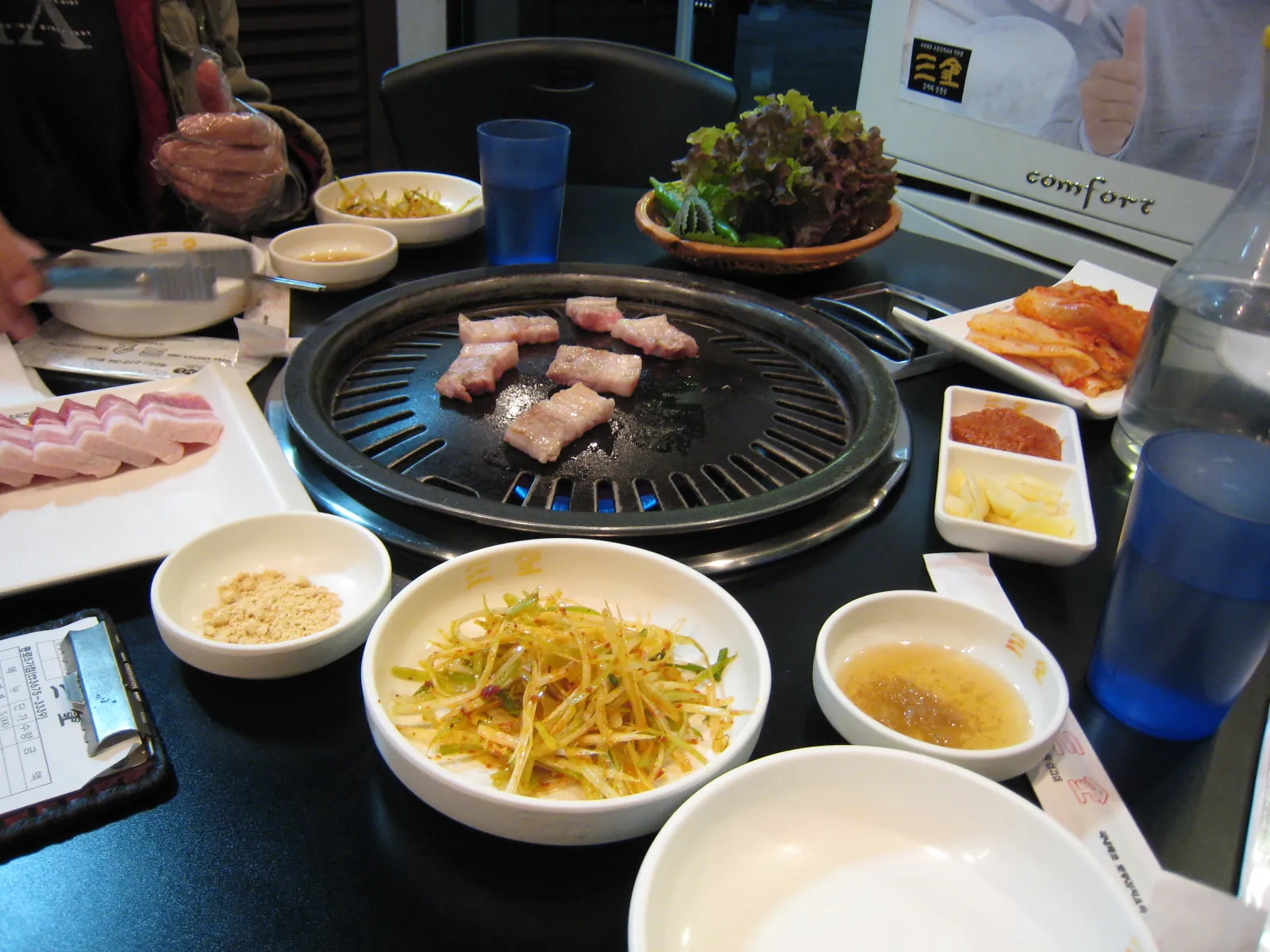
The first thing Seoul teaches a solo traveller is arithmetic. Korean barbecue, the meal you probably flew here for, is sold by the portion, and the minimum order is two. Walk into a busy pork-belly place at seven on a Friday and you'll be told this politely, with a glance at the empty chair opposite, and now and then there simply isn't a table for one. It isn't rudeness. The grill costs money to light, and the city assumes you came with somebody.
I find that oddly useful. Most cities let you drift through a week without deciding whether you want company. Seoul asks on the first night, at a restaurant door, and the rest of the city is built to answer: mountains inside the city limits where strangers hand you fruit at the summit, a river bank where fried chicken arrives by scooter to your patch of grass, Euljiro alleys where the tables are plastic and nobody minds who sits at them.
Finding that second person gets the longest section below, but not the first one; Seoul gives you a morning of logistics before it gives you a dinner. Everything is priced in Korean won as of September 2026. Korea raises fares in ₩100 and ₩150 steps — the subway in June 2025, the airport express since, the palaces due next — so every number here has an invisible "about" in front of it.
Seoul solo travel at a glance
| Is it safe alone? | Very. Real hazards: taxi overcharging and delivery scooters on pavements. |
| How many days | 4 full days; 3 at a push; 5–6 with a hike and the DMZ |
| Best months | April–May and October. Avoid the July monsoon and Chuseok (24–26 Sept 2026). |
| Daily budget | ₩60,000–80,000 on a dorm-and-gukbap budget; ₩200,000–280,000 comfortable |
| Getting around | Subway (₩1,550 base) with a T-money or Climate Card; Uber or k.ride for taxis |
| Where to sleep | Hongdae for company, Jongno for the old city, Itaewon for bars, Myeongdong for convenience |
| Language | English on every subway sign; on menus, less so. Papago for the rest. |
| Payment | Cards almost everywhere, market stalls included. A little cash for old places. |
| The apps to install | Naver Map (Google Maps barely works here), Papago, Uber. Then MeetMap, for a second seat at the grill. |
Is Seoul safe for solo travellers?
Yes, by a wide margin. Violent crime against visitors is close to nonexistent, people leave laptops on café tables while they go to the toilet, and I've walked home through Jongno at 2am more times than I can count with nothing happening beyond a drunk salaryman wishing me goodnight. There are police boxes at the big stations and a 24-hour tourist helpline on 1330 in English, Chinese and Japanese.
What Seoul has instead is a short list of things that actually go wrong.
Taxi overcharging. The one that matters. The case that made the news in July 2026: a Taiwanese visitor booked an Uber in Jayang-dong, in the east of the city, changed the destination from Seoul Station to Incheon Terminal 2 on the way, and at the terminal the driver had him pay on the in-car card machine rather than in the app. He was charged ₩690,800, of which about ₩66,000 was tolls. The honest fare, tolls included, is around ₩70,000; the driver's explanation was that "an extra zero" had gone in. He was promised a refund once the story went round, which is not a plan. The city has been running crackdowns since 2025 (139 airport overcharging cases caught in the first half of that year), there are QR complaint cards at both airports, and since the winter of 2025–26 receipts show the fare, the tolls and any surcharge in English. Even so, around Myeongdong, Hongdae, Gangnam and the airports some drivers still quote flat fares to anyone who doesn't look Korean. So: book in an app, keep the destination in the app, pay in the app. If a driver won't start the meter, take the next one. And walk past anyone inside the Incheon arrivals hall offering a "cheap" van; they're not licensed.
The "cultural survey" recruiters. Two well-dressed young people near Hongdae station or in Myeongdong, doing a "project on Korean culture", ending in an invitation to a tea ceremony. It's a religious group recruiting. Harmless, an hour gone. "No thanks" works.
Delivery scooters. Honestly the likeliest way to get hurt here. Riders use the pavement as a second road at dinner time. Look both ways, even on a footpath.
Crowds, ice and dust. Since the Itaewon crush of October 2022, Halloween there is heavily policed; still, if an alley gets so packed you can't choose your direction, turn round. Pavements ice over in January. In March–May yellow dust can push air quality into the red; check the AirKorea app and skip the hike when locals are masked.
The rest is the list you'd use at home — watch your glass, keep the phone in a front pocket on a Saturday night in Hongdae, and if you're meeting someone you've only talked to on a screen, let a friend know where — and it's written up properly on our safety page.
Is Seoul safe for solo female travellers?
Yes, and it's one of the cities solo women most often say they felt at ease in. Street harassment is rare, the subway is busy until it stops around midnight, and app-booked taxis show plate and route to whoever you share it with. Two local notes. Hidden-camera crime (molka) has been a real problem here; police take it seriously and station toilets are checked, but department-store and hotel ones are the calmer choice. And people will pour for you all night; geuman, "I'm done", is a full sentence nobody decent argues with.
When to go
Four real seasons, and the wrong month costs you more here than in most Asian capitals.
- March is the tail of winter: highs around 11°C, lows near freezing, the first dust days. Cheap, quiet, not pretty.
- April is cherry blossom, usually peaking in the first half of the month at Yeouido and Seokchon Lake (some years it's the last days of March), highs about 17–18°C. Book early.
- May is the best month: 24°C, dry, the whole city outside, and the palaces open at night from mid-May to mid-June.
- June to August: the monsoon (jangma) arrives in the last week of June and runs about four weeks — not a shower a day, days of rain — then July and August are 29–30°C and humid, with nights that don't drop below 22°C. River at night, museums by day.
- September is 25–26°C highs and the start of Gyeongbokgung's autumn night openings (a month from early September). The catch is Chuseok, the harvest holiday — in 2026 Thursday 24 to Saturday 26, and the Sunday after is just as dead — when markets and family restaurants shut, trains sell out and the palaces go free and packed. The Yeouido fireworks, the river's most crowded night of the year, used to land on a late-September or early-October Saturday; in 2026 they were moved up to 5 September to dodge Chuseok, so check the date before you plan around them.
- October is the other best month: 20°C days, blue skies, and foliage on Bukhansan and the city wall from late October into early November.
- December to February is cold: daytime highs of about 4°C in December, 1–2°C in January, nights around –6°C and now and then –10°C with the wind off the river. Dry, bright, cheap, and the winter lanterns around Gwanghwamun are a real reason to come. Bring a proper coat, not a fashionable one.
How long to stay
Four full days is the right number. In three you can do the palaces, one mountain, one market, one evening on the river and one neighbourhood, but you'll be on the airport train wishing you'd stayed. Five or six is the DMZ and a second mountain. Past that, take the KTX to Busan and come back through Seoul at the end.
Where to stay in Seoul on your own
Choose a district, not a hotel. Each of Seoul's districts has its own crowd, and the subway ride between them is long enough that you'll mostly stay in the one you sleep in. Hotels I'll leave to the booking sites; hostels here open and close on a two-year cycle and any name I gave you would be stale.
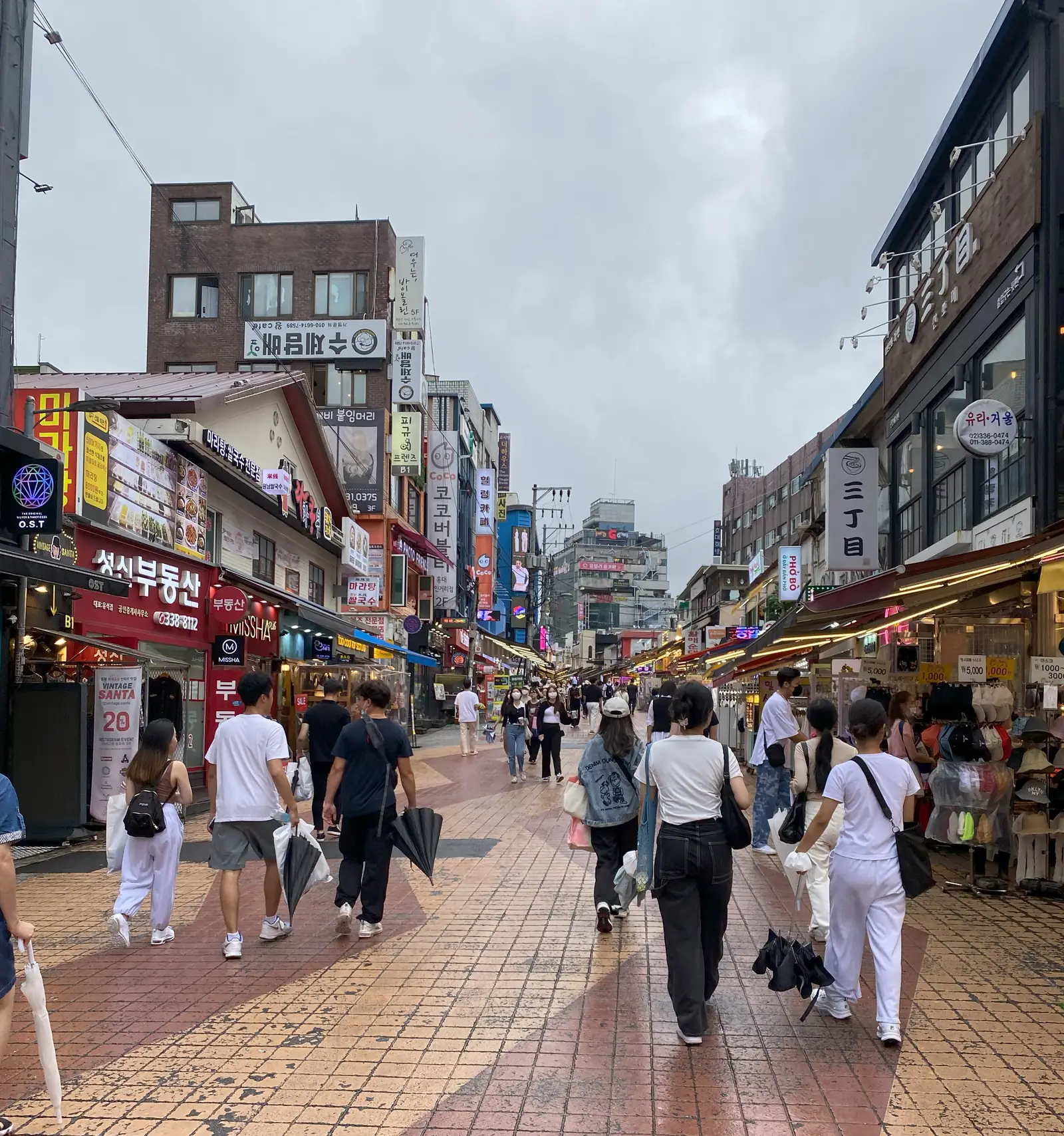
Hongdae (and Yeonnam-dong next door). The university district on line 2 and the AREX. This is where the hostels are and where a solo traveller has the best odds of company by the second night: several have a bar in the basement or a rooftop, and Yeonnam's cafés along the old railway park are where your mornings go. Loud at weekends; sleep in Yeonnam if that bothers you.
Jongno, Bukchon and Seochon. The old city, between the palaces. Quiet after nine, walkable to everything on day one, and where the hanok guesthouses are — a night on a heated floor in a courtyard house is worth doing once. Where I'd stay if company weren't the priority.
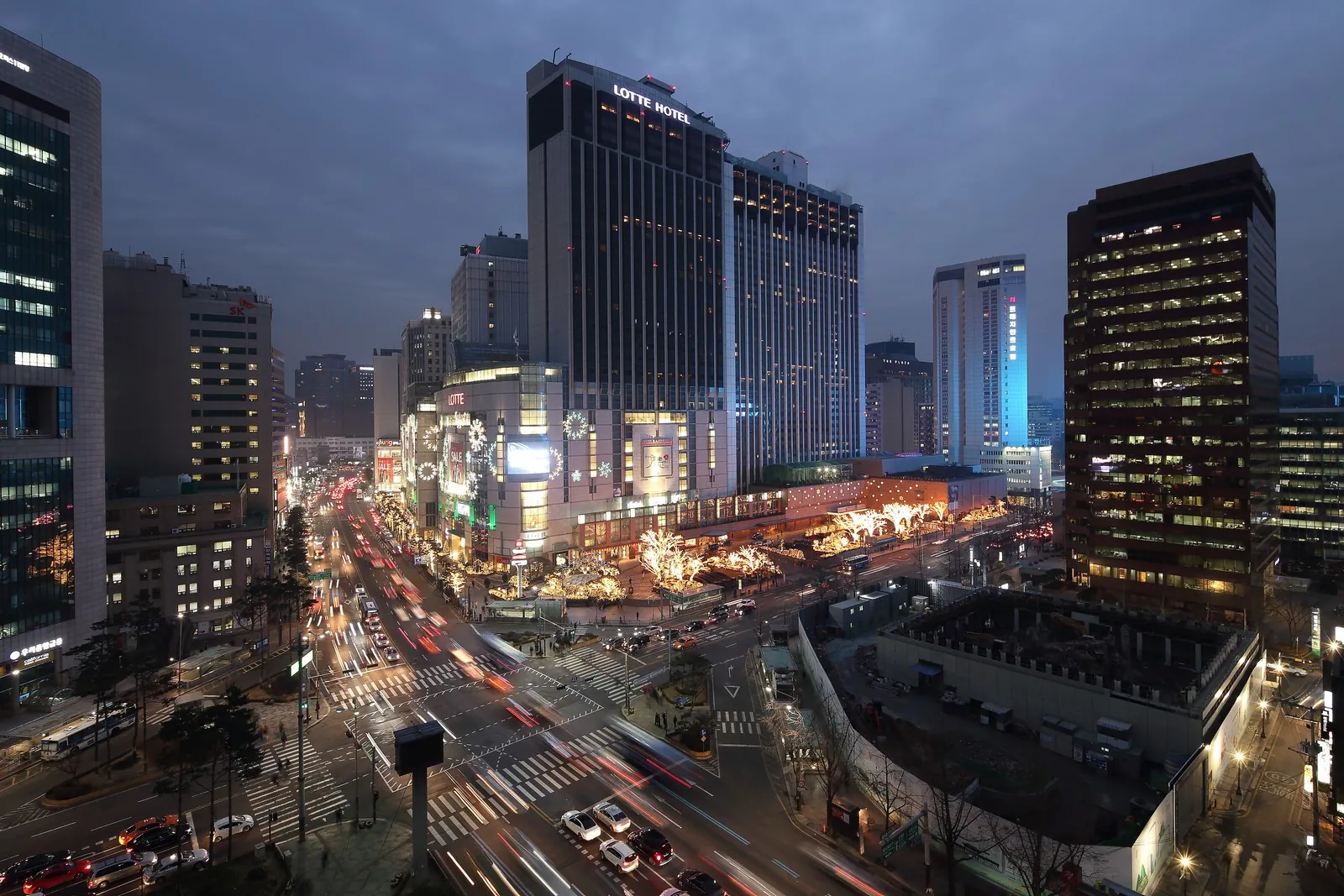
Myeongdong and Euljiro. The most convenient base: lines 2 and 4, the airport bus at the door, business hotels at fair rates. Myeongdong is cosmetics shops and tourist street food; Euljiro behind it is print shops by day and plastic tables by night.
Itaewon and Haebangchon. The expat strip on line 6, under Namsan. The most international bars, hostels with rooftops, the easiest place to start a conversation in English. Twenty minutes from the old city.
Seongsu is roasteries in warehouses and Seoul Forest — great for a day, an awkward base. Gangnam is forty minutes from everything a first-timer wants; skip it.
Roughly: a dorm ₩20,000–40,000 by month, a private guesthouse room ₩50,000–90,000, a business hotel ₩90,000–160,000, a hanok room ₩70,000–150,000. April, October and Chuseok are the dear weeks. Two nights is enough to learn whether you picked the right district; book the rest from a café there.
Getting around
From Incheon Airport (ICN). The AREX Express runs non-stop to Seoul Station in 43 minutes from Terminal 1 (51 from Terminal 2). Around ₩13,000 at the machine now (it was ₩11,000 not long ago), a little less if you book online the day before. The all-stop AREX is the one I use: about ₩4,750 from Terminal 1 and ₩5,350 from Terminal 2 with a T-money card, 59–66 minutes, stopping at Hongik University (Hongdae) and Gongdeok on the way, which for most hostels beats the express. Limousine buses are around ₩17,000, 70–90 minutes in traffic, hotel-door stops — 6015 for Myeongdong, 6002 for Hongdae and Jongno. A taxi is ₩65,000–85,000 with tolls, 60–80 minutes; use the rank outside, not anyone inside. Gimpo (GMP), the short-haul airport, is on lines 5 and 9 and the AREX: about ₩1,500–1,700, 25–35 minutes.
T-money. ₩3,000–4,000 at any convenience store; top up with cash and tap on every bus, train and taxi in the country. Bus–subway transfers within 30 minutes are free.
Climate Card. The tourist pass: unlimited subway, city buses and Ttareungyi bikes for ₩5,000 (1 day), ₩8,000 (2), ₩10,000 (3), ₩15,000 (5) or ₩20,000 (7), plus ₩3,000 for the card. It doesn't cover the AREX express, the Sinbundang line or the airport train beyond Gimpo (so not your ride in from Incheon), and it pays off at five-plus rides a day — which a palaces-plus-river day is.
Subway. The best in the world, I'd argue. ₩1,550 with a card for the first 10 km, then about ₩100 per extra 5 km; roughly 5:30am to midnight. English signs, numbered exits, platform doors, and Naver Map tells you which carriage to stand in.
Buses. Blue and green ₩1,500, yellow village buses ₩1,200, red expresses to the suburbs ₩3,000. Naver Map's bus directions are accurate to the minute; follow them without checking.
Taxis. ₩4,800 for the first 1.6 km, then about ₩100 per 131 m or 30 seconds; plus 20% from 10–11pm and 2–4am, 40% from 11pm to 2am. Every cab takes cards. Kakao T has most of the drivers but tends to stall at sign-up with a foreign number and card, so use its English sibling k.ride, or Uber, which works with the account you already have; both show the fare before you get in. After the last train, a cross-town taxi is ₩15,000–25,000.
Ttareungyi bikes, the green city hire bikes, are ₩1,000 for an hour or ₩2,000 for two through the Seoul Bike app (a seven-day pass is a few thousand won more); the flat river paths were built for them. Walking works inside a district. Crossing from one to the next on foot usually involves a hill that looked flat on the phone, so take the train for anything over two stops.
Things to do alone in Seoul
Twelve things, sequenced for four days. Cut from the bottom if you're short — the DMZ goes before Bukhansan does.
1. Gyeongbokgung at opening, then Seochon
₩3,000 (a rise to several times that is planned for 2027), from 9am, closed Tuesdays, Gyeongbokgung station (line 3, exit 5). Go at nine and catch the guard change at the main gate at ten. A full hanbok gets you in free; rental shops outside charge ₩15,000–20,000 for two hours. Leave by the west gate into Seochon, the low-rise neighbourhood of alleys and small restaurants, for lunch.
2. Changdeokgung and the Secret Garden
The prettier palace, ten minutes east (Anguk, line 3). ₩3,000, closed Mondays. The Secret Garden behind it is around ₩5,000 more and guided tour only; book on the palace website in blossom or foliage season. If you see one palace, see this one. The integrated ticket for the four palaces plus Jongmyo Shrine is ₩10,000, valid three months, and it does include the Secret Garden — but you exchange it for a garden slot at the Changdeokgung ticket office on the day, so it's no use for the online booking. Buying the garden on its own is ₩5,000: online from six days ahead, or at the gate, where half of each tour's hundred places are held back for walk-ups.
3. Bukchon, inside the hours
The hanok village between the palaces is a lived-in neighbourhood, and since 2025 the busiest lanes around Bukchon-ro 11-gil are closed to tourists outside 10am–5pm, with a ₩100,000 fine. Go mid-morning on a weekday, keep your voice down, don't open anyone's gate. The famous view down over the tiled roofs to Namsan is at the top of the lane.
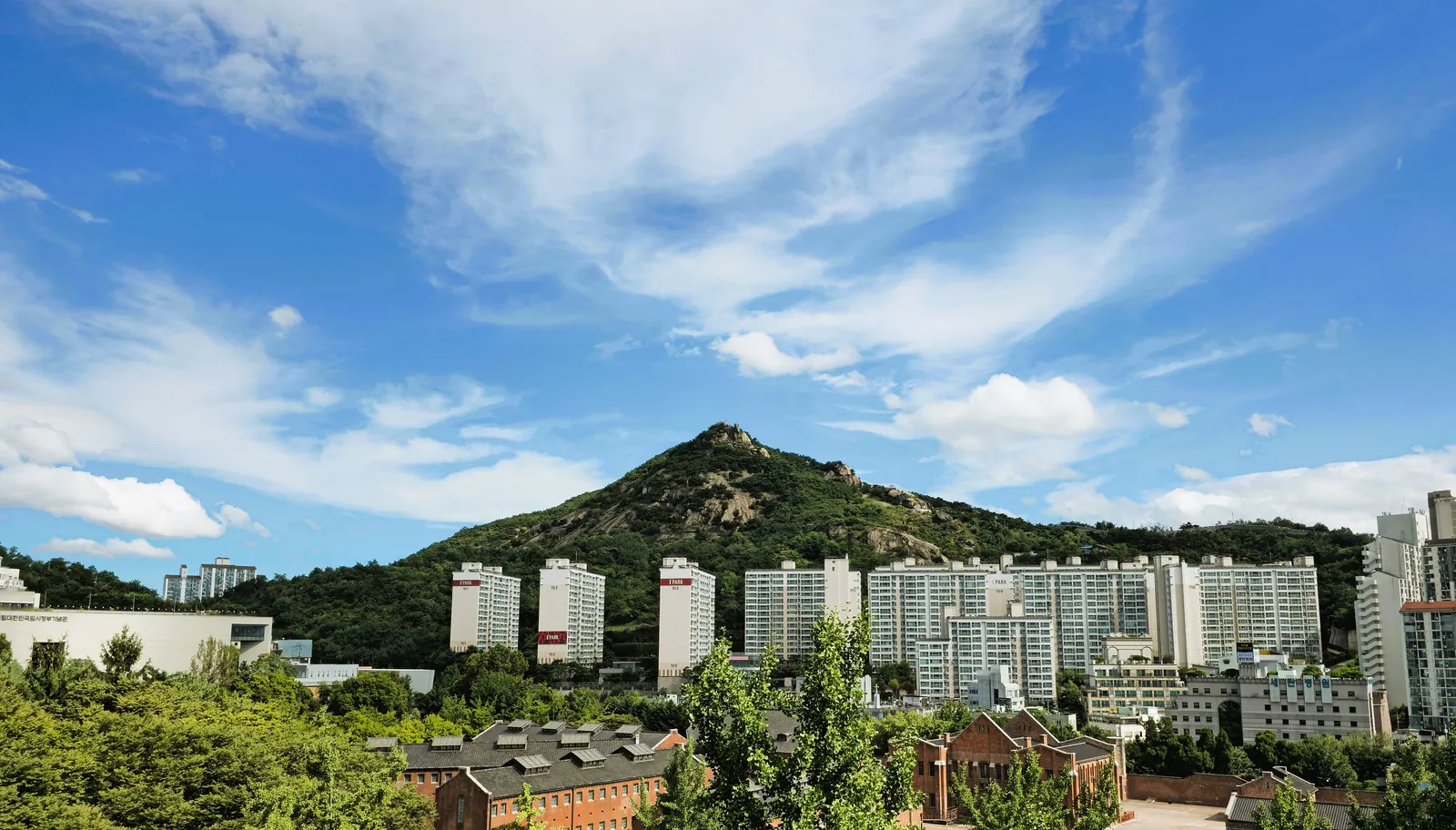
4. Bukhansan, the mountain inside the city
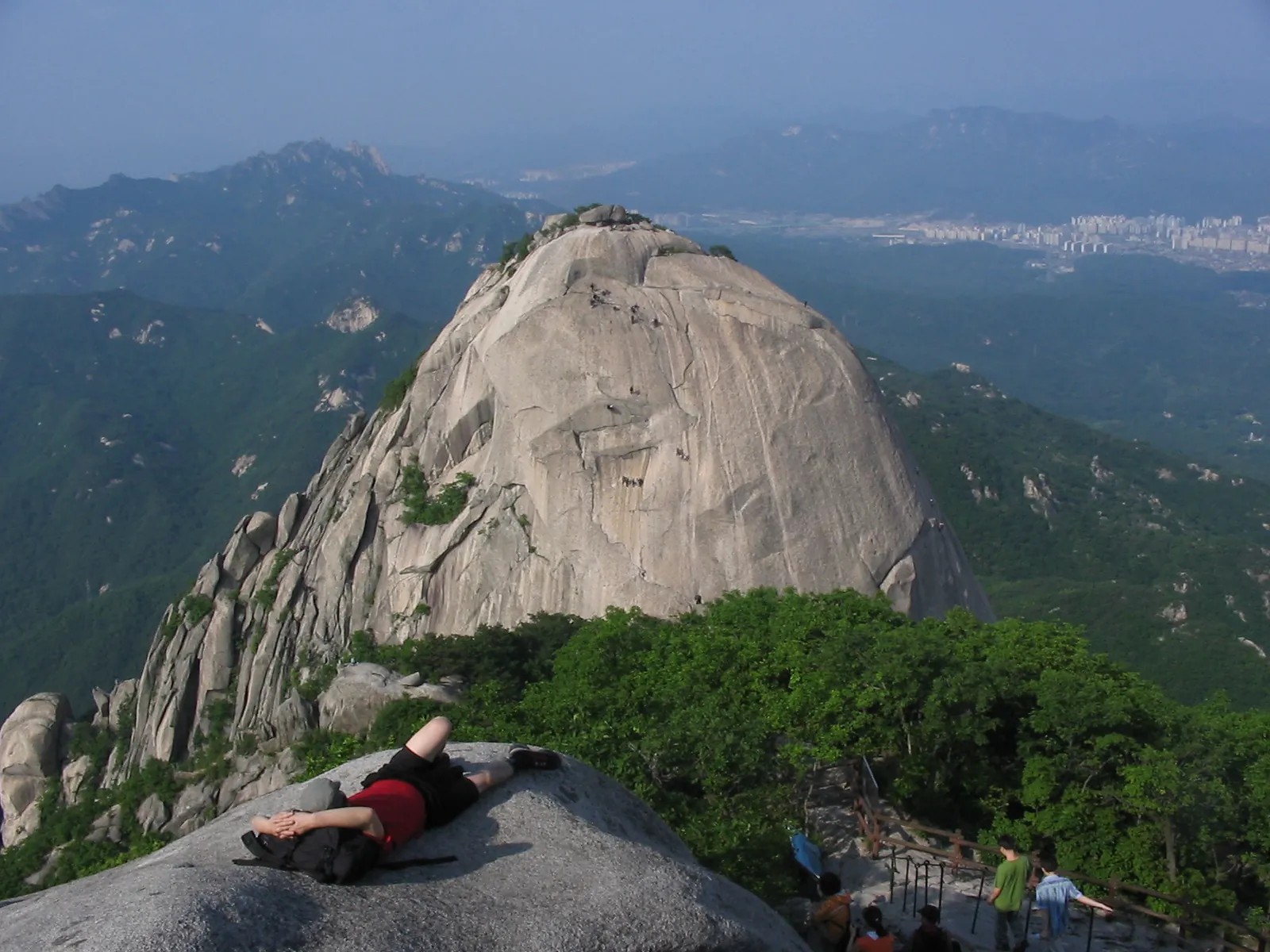
Ui-Sinseol light rail to Bukhansan Ui; the Seoul Hiking Tourism Centre by the station lends boots, poles and jackets to foreigners for little or nothing (closed Mondays). The classic route to Baegundae, the 836 m summit, is three to four hours up and down, ending in a granite scramble with cables. Park entry is free. Sunday mornings are a river of Koreans in full technical gear, and yes, someone will offer you a slice of apple at the top.
5. Inwangsan on the city wall, for sunset
The two-hour hike. From Dongnimmun (line 3) or up from the Gyeongbokgung side, follow the old fortress wall to the 338 m top: the palaces below, Namsan opposite, Bukhansan behind. Free, marked, fine in trainers. Naksan, on the eastern wall above Dongdaemun, is the gentler version with half the climb.
6. Namsan on foot, tower optional
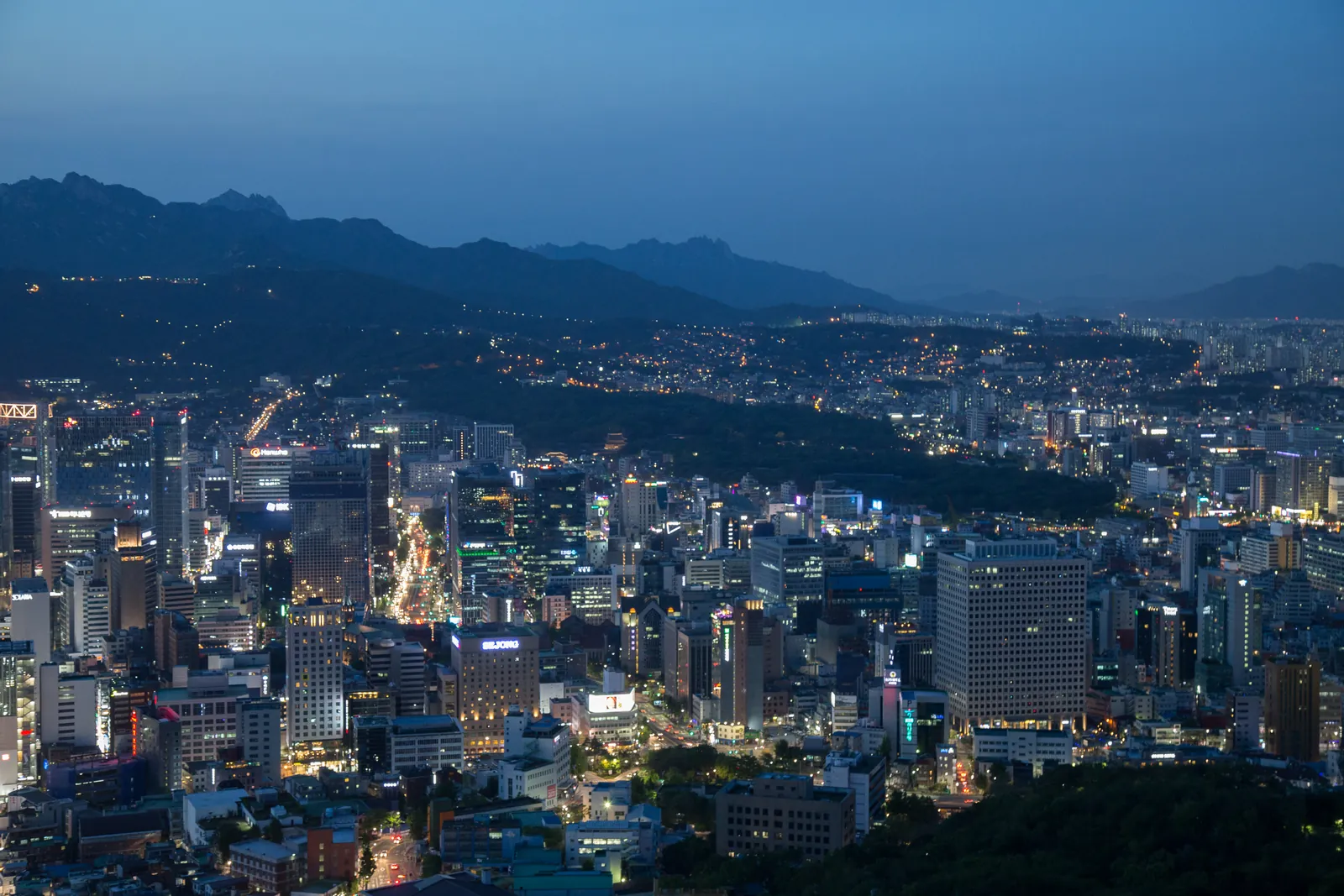
Walk up from Myeongdong — the path starts behind the cable car station — forty minutes through trees to the base of N Seoul Tower. The terrace is free and has most of the view; the observatory is around ₩29,000 at the door in 2026 and a good deal less booked online, which is the only sensible way; the cable car is about ₩15,000 return if the walk isn't happening. Go at dusk for both the daylight city and the lit one.
7. The Han River in the evening
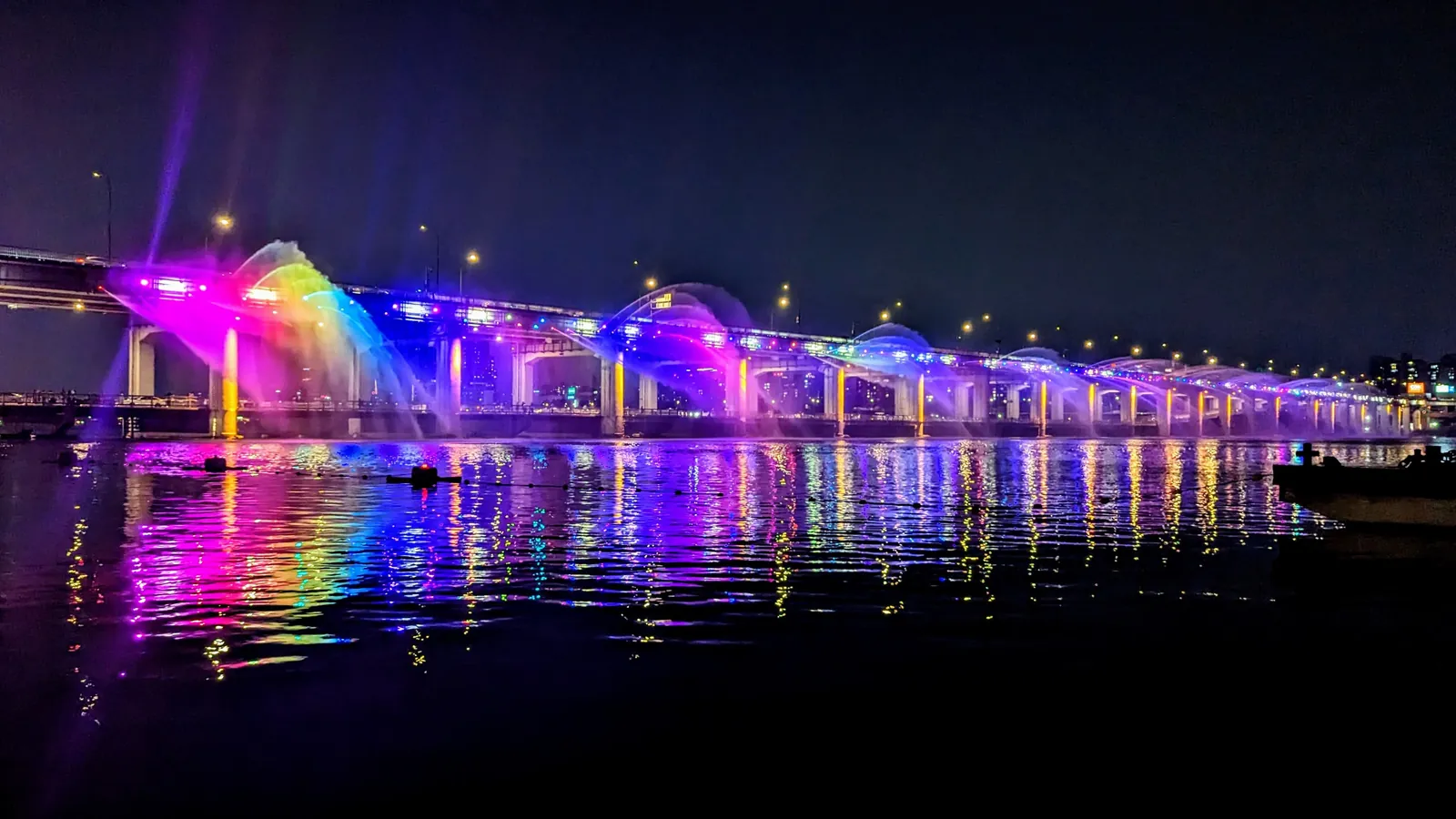
Banpo Hangang Park (Express Bus Terminal, lines 3/7/9) or Yeouido (Yeouinaru, line 5). Beer and ramyeon from the riverside convenience store, or fried chicken by delivery app to the numbered pillar you're sitting by. Drinking outside is legal. April to October the Banpo Bridge fountain runs in the evening. Around ₩10,000 for the evening, all in.
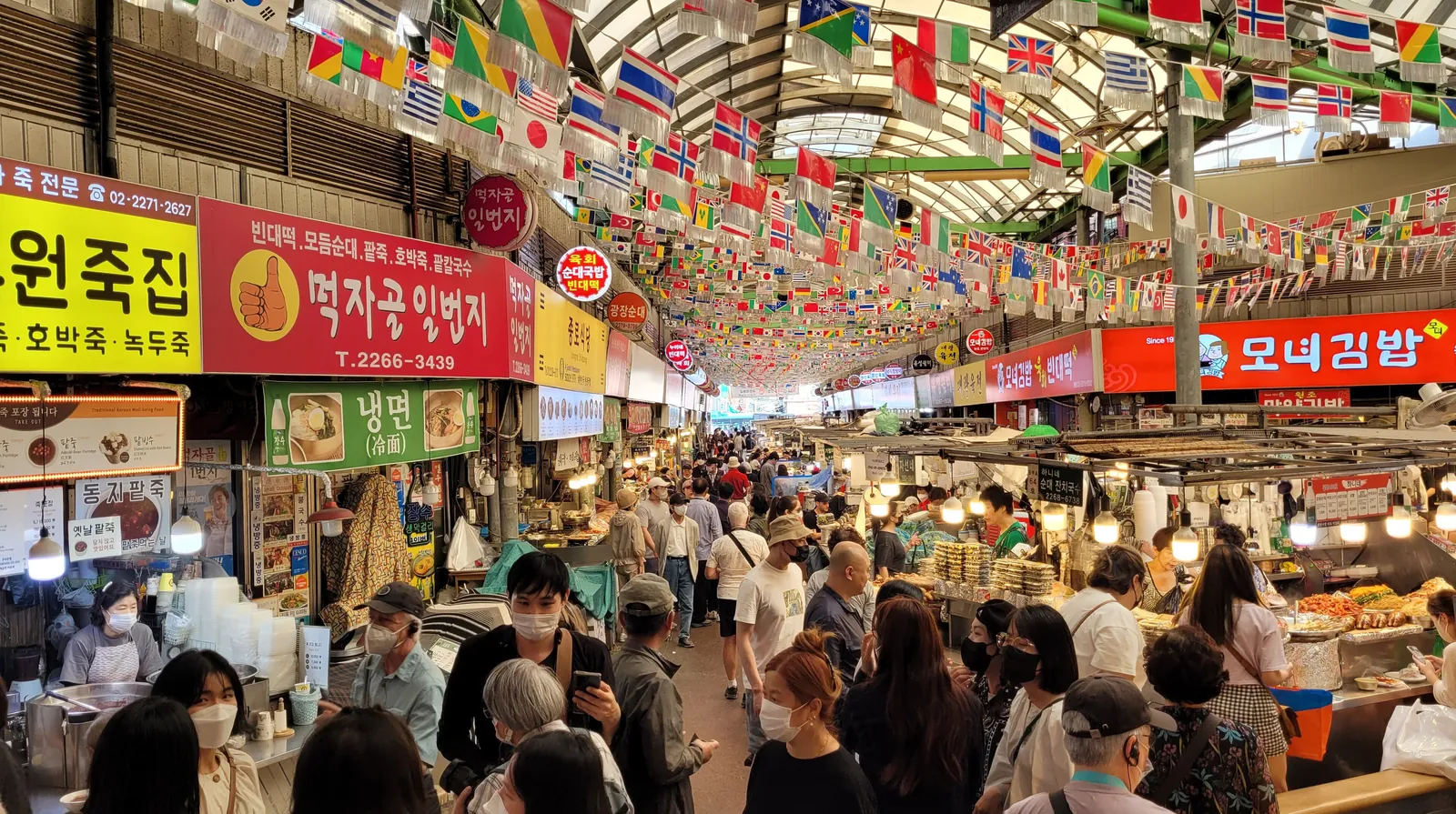
8. Gwangjang Market
Jongno 5-ga (line 1, exit 8). The old market's food alley is counter seating only, which makes it the easiest sit-down meal for one in the city. Bindaetteok, the mung-bean pancake, around ₩5,000; the "narcotic" mini kimbap ₩3,000–4,000; raw beef (yukhoe) at the back ₩15,000–20,000.
9. A cooking class
Two to three hours, ₩55,000–110,000 depending on whether it starts with a market walk, classes of six to eight, and dinner is whatever you made. Most of the good ones meet at Gwangjang or a neighbourhood market first. Schedule it for your first full evening; the reason is in the meeting-people section.
10. A jjimjilbang
The 24-hour bathhouse: hot pools, saunas at various temperatures, a heated floor to sleep on, an egg-and-sikhye snack bar. Around ₩12,000–20,000 in, ₩20,000 more for a scrub that removes a layer of you. Siloam near Seoul Station is the classic. Nobody cares that you're alone or naked; the baths are single-sex and everyone is.
11. Euljiro after dark
Euljiro 3-ga (lines 2/3). The old lighting and print district, where from six the alleys fill with plastic tables, cheap draught beer and dried pollock (nogari) grilled at your table for ₩3,000–5,000 a fish. Above it, Sewoon Sangga, the 1960s electronics arcade, has a rooftop walkway with a view you'd pay for elsewhere.
12. The DMZ
A half or full day by tour bus: the third tunnel, the Dora observatory looking into the North, the last station before the border. ₩55,000–95,000 depending on lunch and operator; bring your passport. Panmunjom itself — the blue huts where you once stepped over the line — has been closed to tourists since a US soldier ran across it in July 2023. Since 2025 a few operators sell a limited "JSA" add-on that runs a handful of days a month and stops at the visitor centre, so read exactly what you're buying.
Eating alone in Seoul
Good news first. Honbap, eating alone, went from faintly embarrassing to completely normal in the last decade; at lunch in a business district more than half the tables are singles. Whole categories are built for one: gukbap, rice in pork or beef broth, ₩9,000–12,000 and a full meal; kimbap from a chain like Kimbap Cheonguk, ₩3,500–5,000; naengmyeon, bibimbap, sundubu stew in its own pot, any noodle. Department-store food courts are cheap and half solo diners, and a convenience store with a counter is a legitimate dinner in this country.
Now the catch. The dishes Seoul is famous for are two-person dishes by rule. Barbecue is 2인분 minimum almost everywhere — two portions of pork belly at a normal place is ₩16,000–28,000, fine in itself, but the grill, the side dishes and the rhythm of the meal are designed around a table. Jjigae and jeongol hot pots come in a pan for three. Chicken and beer is legal alone and slightly sad alone.
The workarounds are real. Search Naver Map for 혼밥 고기집 (solo barbecue) or 1인 화로 (individual grill) for counter places, mostly near universities and offices, with a small grill per seat and one-portion pricing around ₩8,000–14,000. Lunch is easier than dinner; the rule bites hardest at seven on a Friday. I've stopped fighting it. Gukbap and kimbap I eat alone; for barbecue I go and find someone, and the next section is how.
How to meet people in Seoul
Seoul's social life runs on its own machinery — hostels with bars, mountains, running clubs, plastic tables — and most of it will take an outsider who turns up at the right hour. What follows is the timetable.
Sleep in Hongdae, in a place with a bar. A hostel with a pub in the basement, or a kitchen where everyone cooks at the same hour, will have found you dinner company by the second night without your doing anything. Too old for a bunk? Most of these places have private rooms on the upper floors, and the bar downstairs doesn't check. A hanok in Bukchon is beautiful and you'll meet nobody.
Book the cooking class for your first evening. Three hours of chopping shoulder to shoulder, then a table where everyone eats everyone else's mistakes; by the washing-up somebody is heading to Hongdae and asks if you're coming. The drop-in K-pop dance classes in Hongdae (₩30,000–50,000 for ninety minutes, beginners welcome) produce the same group with more sweat.
Go up a mountain. Hiking is the national pastime, and Korean hiking culture is social in a way that's hard to explain until a retiree hands you a cucumber on a ridge. The hiking centre at Bukhansan Ui runs guided hikes for foreigners (book a few days ahead), and "Inwangsan, Saturday 9am, two hours" is the easiest plan in this city to say yes to, because it's over before anyone has to be brave for long. The group always ends up at a makgeolli place at the bottom; stay for it.
Run the river. Seoul Flyers, the big English-speaking running club, meets Saturday mornings at 8:30 by the convenience store in Ichon Hangang Park (Ichon, line 4, exit 4, then straight on to the river): 5 or 10 km, no set pace, breakfast after. Their Meetup page has that week's details. Also on Meetup, the Seoul hiking and board-game groups are the two that actually meet weekly; the weeknight crews that run the Han post on Instagram. Nobody will remember you the first Saturday. The second, someone asks your name.
Try a language exchange, once. Hongdae has them Wednesday to Saturday evenings for a few thousand won, tables rotating every forty minutes; everyone came to meet people and nobody's in charge, but as a first night they're fine.
Use the counters and the alleys. Euljiro after six, where the next table is a forearm away; the counters at Gwangjang; the plastic chairs outside any convenience store, which Koreans treat as a bar whose cover charge is one can of beer. Point at the nogari and ask how you're supposed to eat it; someone will show you.
Know the customs. An evening comes in rounds: il-cha is dinner, i-cha the bar, sam-cha the noraebang; an invitation to dinner may mean all three, and when you invite, say how many you mean. Pour for others, not yourself, and take the first glass with two hands. Swap Kakao or Instagram immediately — plans here live in group chats, and "let's hang out sometime" without a chat attached is just manners. People work late: weekday plans start at eight; the real hours are Friday night and Saturday.
Learn to read an invitation. In Seoul a real plan has a station exit and a time in it — "Euljiro 3-ga, exit 4, seven" — and once someone has said that to you, you go, museum or no museum. Anything without an exit number ("you should come out with us while you're here") is warmth, not a plan, and nobody will be offended if it never happens. There's a longer piece on this, how to meet people in a new city when you know nobody, and the short Seoul post goes into the rounds and the river.
Supply the missing person. At seven o'clock, half the solo travellers in Seoul are outside a barbecue place doing the arithmetic from the top of this guide. Write "samgyeopsal in Euljiro, 7pm, need one more" on the hostel whiteboard and you've solved it for two people at once — the two-portion rule is on your side here, because the other person needs you exactly as much as you need them.
And the app we built for exactly this. MeetMap is a map of small plans happening soon near you: a coffee at eight, a hike on Saturday, a barbecue table with one seat left. Each pin shows the time, the place and how many seats remain; take one and you're in the group chat. Looking is free, it isn't a dating app, and it exists because every solo traveller has stood outside a barbecue restaurant doing the arithmetic. If the map is quiet in Seoul when you open it, post the first plan — "Euljiro, 7pm, one seat" — and see who takes it.
What Seoul costs per day
Per person, per day, in won; ₩10,000 is about US$7.
| Budget | Mid-range | Comfortable | |
|---|---|---|---|
| Bed | 30,000 (dorm) | 120,000 (business hotel) | 250,000+ |
| Food | 25,000 (gukbap, kimbap, market) | 50,000 (one proper dinner) | 100,000+ |
| Transport | 5,000 (Climate Card) | 15,000 (subway plus a taxi) | 30,000 |
| One activity | 3,000 (a palace) | 70,000 (a class or the DMZ) | 100,000 |
| Day | ~60,000–70,000 | ~250,000 | 480,000+ |
Cards work almost everywhere — taxis, market stalls, every convenience store — and you can do a whole trip on a foreign Visa or Mastercard. Keep ₩50,000 or so for old places and street stalls. Nobody tips: not taxis, not restaurants, not the jjimjilbang scrub lady, and trying to will cause a small polite scene. "Global ATM" machines in convenience stores take foreign cards for around ₩3,000–4,000 a withdrawal.
A three-day Seoul plan for one
Day 1 — The old city. Gyeongbokgung at nine, guard change at ten, west gate to Seochon for lunch. Bukchon after twelve, inside the hours; Changdeokgung and the Secret Garden mid-afternoon if you booked. Inwangsan for sunset. Cooking class in the evening, or the Gwangjang counter and an early night.
Day 2 — Mountain and river. Bukhansan from Ui station by eight; down by one, makgeolli at the bottom. Jjimjilbang for two hours. Banpo from six: ramyeon from the store, chicken by delivery, the fountain. If you've met anyone, this is the evening to invite them.
Day 3 — East and after dark. Seongsu and Seoul Forest in the morning. Dongdaemun for the plaza and market. Euljiro from six — plastic tables, nogari, then barbecue with whoever you found on days one and two, or whoever took the seat you posted. Hongdae busking after.
With a fourth day: the DMZ, or Namsan on foot and Itaewon in the evening.
FAQ
Is Seoul good for first-time solo travellers?
One of the best cities in Asia for it: extremely safe, a subway you can't get lost on, and a food culture that has accepted eating alone — except the barbecue, which is the reason to meet people. The language barrier is real once you leave the tourist zones; install Naver Map and Papago before you land.
Is Seoul safe at night alone?
Yes, everywhere a visitor is likely to be. The subway stays busy till it stops around midnight; app taxis show the route. Watch for scooters on pavements.
Do I need cash in Seoul?
Barely. Cards work in taxis, convenience stores, restaurants and most market stalls. Keep ₩50,000 or so for small old places, and top up a T-money at any convenience store.
Is it easy to meet people in Seoul?
Easier than its reputation, as long as you go where Seoul already gathers: a Hongdae hostel with a bar, the Saturday run at Ichon, a cooking class on night one, Euljiro's tables. The travellers who leave saying Koreans are reserved are usually the ones who slept in Gangnam and ate kimbap in the room.
How much English is spoken in Seoul?
Enough on the subway, in hotels and anywhere aimed at tourists; less in restaurants and taxis. Papago reads menus through the camera, and younger Koreans understand more than they'll admit to speaking.
What should I not do in Seoul?
Get out of any taxi that names a price before the meter starts. Walk on past the "cultural survey" pair. Keep out of the Bukchon lanes before ten and after five. At a Korean table, let someone else fill your glass and fill theirs in return; on a Korean mountain, take the fruit.
Last thing
Seoul is one of the easiest cities on earth to be alone in, and one of the few that will point it out to you at a restaurant door. I've come round to thinking the two-portion rule is doing you a favour: it makes you decide on the first night, and this city has more ways of answering — apple slices from strangers on a ridge, chicken delivered to a patch of grass, a plastic table in Euljiro, a pin on a map — than almost anywhere I know. Somewhere in Seoul tonight a grill is lit for two and one chair is empty. That's your table.
