Home›Blog›Singapore solo travel guide: safety, where to stay, what to do, and how to meet people (2026)
Singapore solo travel guide: safety, where to stay, what to do, and how to meet people (2026)
The first thing Singapore teaches you is a rule about tissues. You walk into a hawker centre at half past twelve, every table looks taken, and then you notice that a lot of the "taken" seats have nobody at them — just a packet of tissues, or a folded umbrella, or an office lanyard, lying on the table. That's chope. Someone is in a queue and the seat is theirs. Put your own packet down, go and get your chicken rice, and come back to a table you are now sharing with four strangers who will not look up.
That is Singapore in one lunch hour. Sitting with strangers was solved decades ago; what comes after was not. Everyone at your table is busy, eats in eleven minutes and goes back to the office. You can spend a week here eating every meal shoulder to shoulder with people and not say a word to any of them.
The other thing you learn fast is the hours. It is around 31°C and humid every day of the year, so the city moves early and late: the reservoir at seven, the office at nine, satay on a closed-off street at half past seven at night. Plan around those hours and Singapore is easy, clean, safe to the point of dullness, and more sociable than its reputation.
Everything below is in Singapore dollars and was true in September 2026; prices here move in one direction only, so leave a little slack.
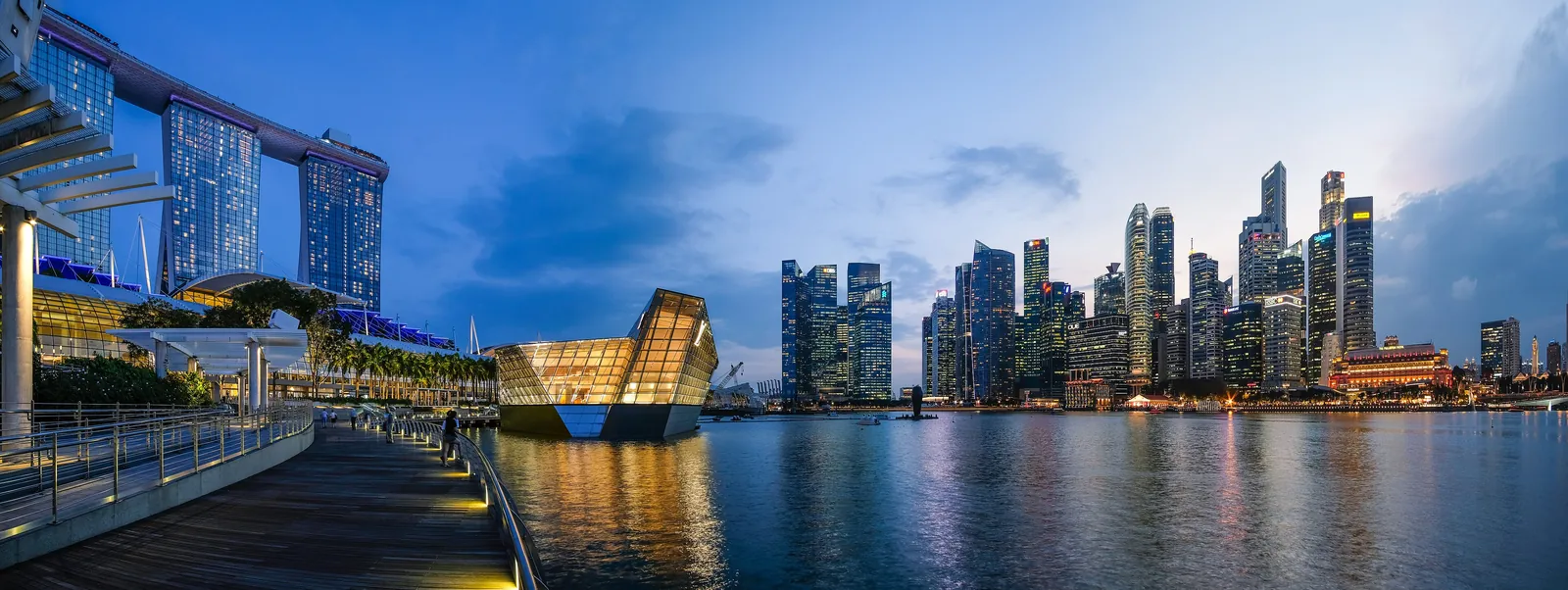
Singapore solo travel at a glance
| Is it safe alone? | About as safe as a city gets. The real risks are fines and lightning, not people. |
| How many days | 3 full days; 4 with Pulau Ubin or the Night Safari |
| Best months | February to April and July to September (drier). Late November to December is the wet one. |
| Daily budget | S$75–90 on a dorm-and-hawker budget; around S$300 mid-range; S$650+ comfortable |
| Getting around | MRT for everything, tap in with a contactless bank card. Grab after midnight. |
| Where to sleep | Chinatown or Lavender for hostels and company; Tiong Bahru or Joo Chiat to feel local; Marina Bay for the view |
| Language | English everywhere; Mandarin, Malay and Tamil are official too. Singlish is what you'll hear. |
| Payment | Contactless card almost everywhere; hawker stalls want cash or a local QR, so carry S$50–100 |
| The one app to install | Grab for the rides. MeetMap for a seat at the satay table (see the meeting-people section). |
Is Singapore safe for solo travellers?
Yes, to a degree that becomes a joke by day two. Laptops sit on café tables while their owners queue for coffee; Chinatown at one in the morning is bothered only by the humidity. So this section is about rules, because the fines are real and some have caught tourists out this year.
Vapes. The one that matters now. Since September 2025 anyone caught with a device, visitors included, has it seized and pays an on-the-spot fine (S$700 for an adult); since May 2026, under the new Tobacco and Vaporisers Control Act, possession alone carries fines up to S$10,000, and nobody should assume the airport is a grey zone. Pods laced with etomidate ("Kpods") are a heavier offence again: up to S$20,000 or ten years. Leave it at home. Drugs proper: trafficking carries a mandatory death penalty; possession is prison.
Drinking in public. Banned between 10:30pm and 7am island-wide, fines up to S$1,000; in the Liquor Control Zones of Little India and Geylang the restrictions extend across weekends and penalties are one and a half times higher. Bars are fine; a park bench at midnight is not.
The MRT and the street. No eating or drinking on trains (up to S$500), no durians. Bringing in chewing gum, littering, jaywalking and smoking outside marked areas: all fined, all enforced.
The SG Arrival Card. Submitted online within three days before arrival, free on the ICA website. Third-party sites charge S$30–60 to "process" it; the immigration authority endorses none of them. That's the one real tourist scam here.
The hazards worth respecting are natural: Singapore has one of the highest lightning-strike rates in the world, so when the sky goes purple over MacRitchie or East Coast Park get under a real roof; dengue is endemic, so use repellent in the parks at dawn and dusk; and the MacRitchie macaques will take a plastic bag out of your hand.
Our safety page has the rules that hold in any city: first meeting somewhere public, someone who knows where you are, your own way home.
Is Singapore safe for solo female travellers?
One of the easiest cities in the world to travel alone as a woman. Walking back to the hostel after midnight is normal, the MRT at night is fine, catcalling barely exists. Geylang is the red-light district — legal, busy, well lit — but expect to be looked at along Lorongs 8 to 20 after dark. The Sultan Mosque and the Hindu temples lend robes at the door.
When to go
Honestly, any month. The difference between seasons is smaller than the difference between 9am and 2pm on the same day: highs of 30–33°C all year, nights around 24–26°C, humidity in the eighties.
- December to early March, the northeast monsoon. December is the wettest month (around 330 mm) with long grey rain. From late January it turns windy and relatively dry; February is the driest month, at roughly a third of December's rain, so February to April is my pick.
- April and May: still, sticky, a spectacular thunderstorm most afternoons.
- June to September, the southwest monsoon: drier, with a "Sumatra squall" before dawn some days and, some years, haze from Indonesian forest fires. Check the PSI before an outdoor day.
- October and November: big afternoon storms, clear evenings.
Rain here comes hard, lasts forty minutes, and the pavement is dry an hour later. Do the outdoor things in the morning.
Festivals. Chinese New Year (17–18 February 2026; 6–7 February 2027) closes many hawker stalls for days, though the fortnight before, Chinatown is lit and loud. Ramadan and Hari Raya Puasa (21 March 2026) bring the Geylang Serai bazaar, the best night market of the year. Deepavali (8 November 2026) has Little India lit up for about a month beforehand. The Formula 1 night race (9–11 October 2026) closes the Marina Bay roads for a week and roughly doubles hotel prices.
How long to stay
Three full days: the hawker centres properly, Marina Bay and the Gardens, a reservoir walk, one museum, Kampong Glam and Little India, the east coast on a bicycle. A fourth is Pulau Ubin or the Night Safari. A fifth is the day you stop sightseeing and just live here — a Tiong Bahru morning, a swim, a long lunch. If you have more than that, Singapore is the wrong place to spend it: Kuala Lumpur is an hour's flight, Johor Bahru is a bus across the Causeway, Melaka about four hours, and the flight home leaves from Changi anyway.
Where to stay in Singapore on your own
Neighbourhood first, hotel second. Everything is twenty to thirty minutes from everything else by MRT, so you're choosing atmosphere and price, not access.
Chinatown / Tanjong Pagar is where I'd send a first-timer who wants company: the densest hostel cluster in the city around Temple Street and Pagoda Street, Maxwell and Chinatown Complex a five-minute walk, Tanjong Pagar's after-work bars next door. Loud until eleven, dead by midnight.
Lavender / Jalan Besar is the other hostel cluster, cheaper and quieter, with cafés around Tyrwhitt Road and Little India a fifteen-minute walk away. Beds run S$5–10 a night less than Chinatown.
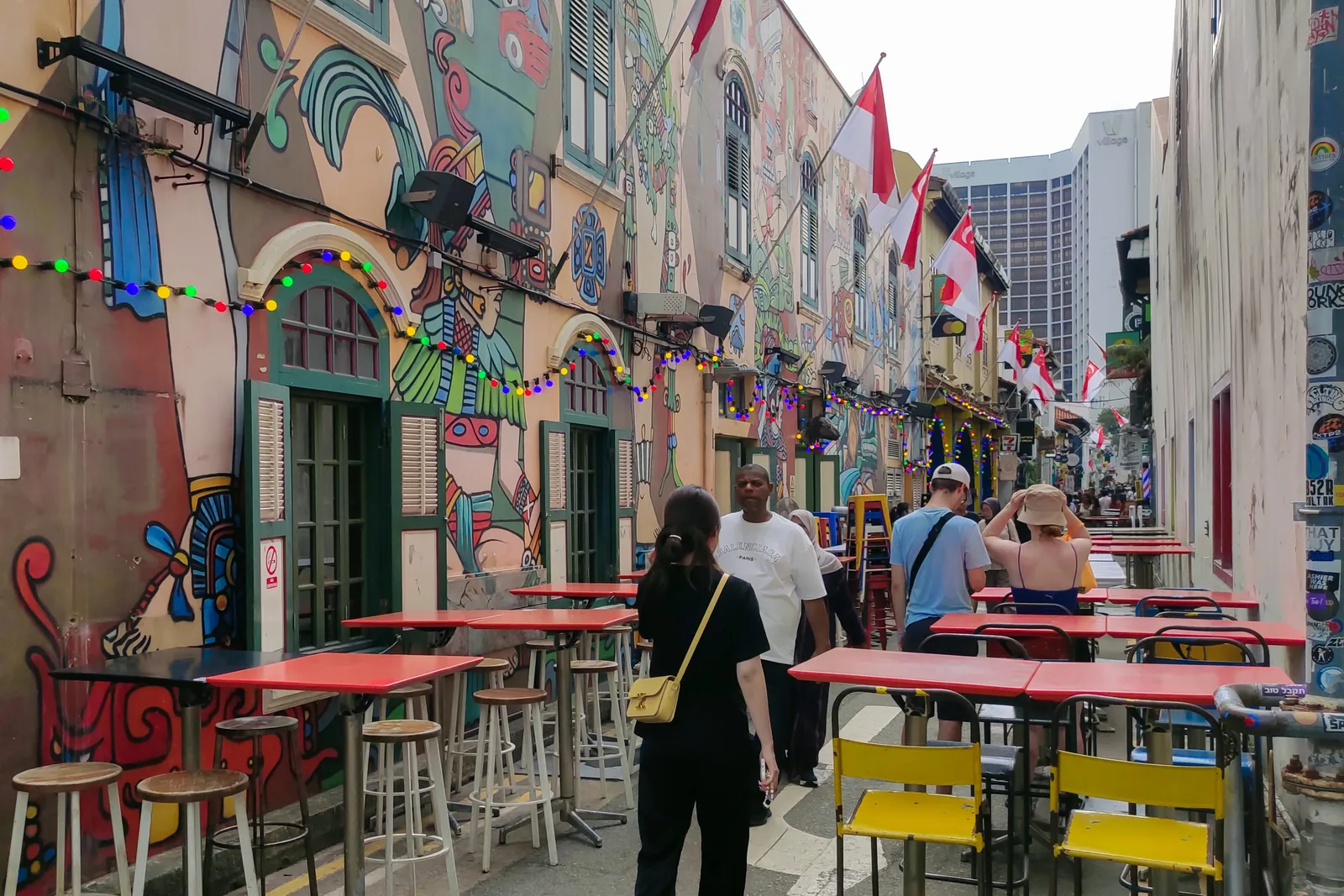
Bugis / Kampong Glam is the middle of the map: Haji Lane's bars, Arab Street, the Sultan Mosque, capsule hostels and boutique hotels in old shophouses. For someone who wants to walk everywhere.
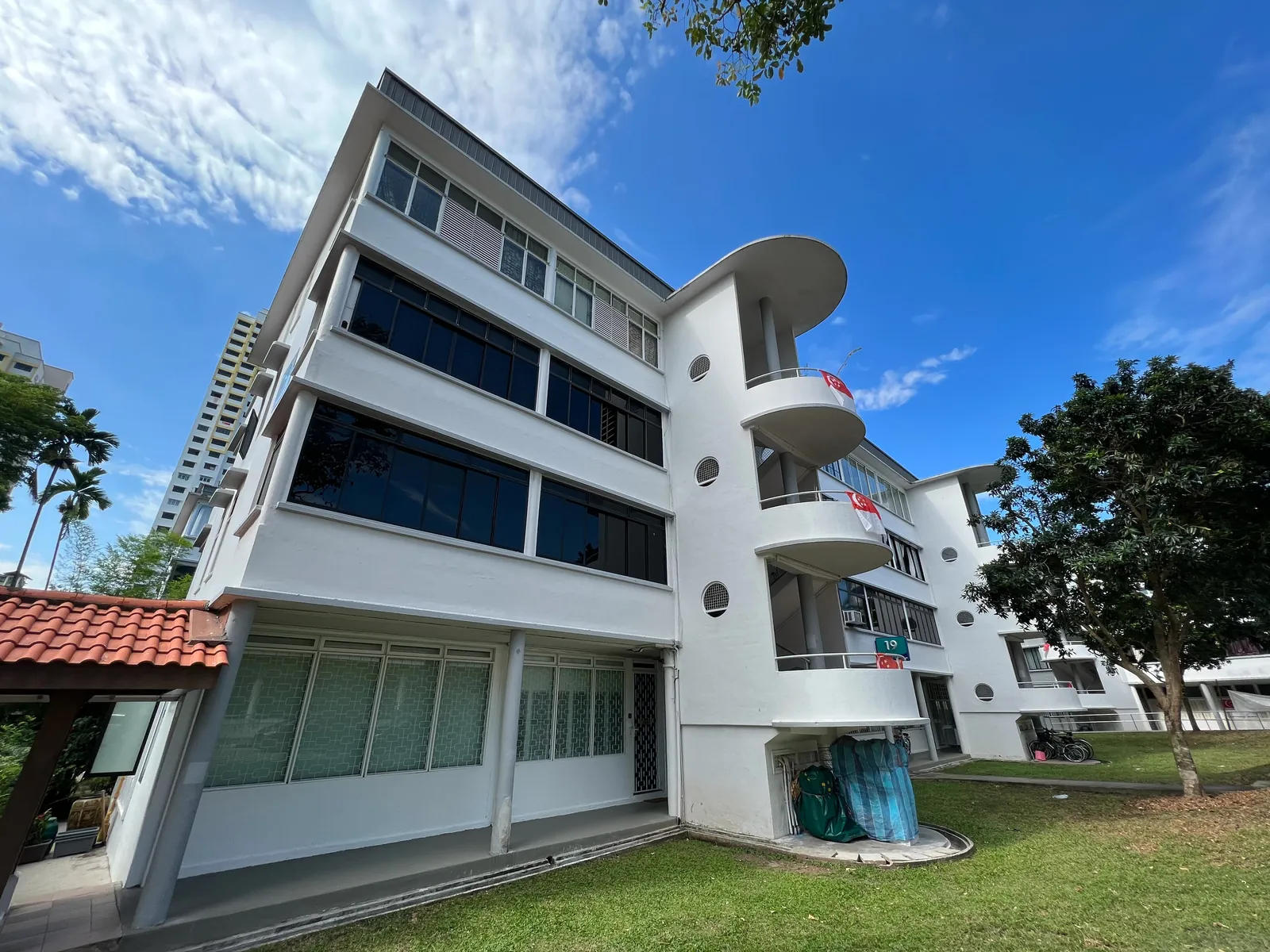
Tiong Bahru is the 1930s low-rise estate with the famous market and the cafés that became the city's living room. Quiet, pretty, few hostels, a couple of boutique hotels, one stop from Chinatown. It's where I'd stay myself.
Joo Chiat / Katong, in the east, is pastel Peranakan shophouses, the laksa argument, and East Coast Park a short bus ride away. Twenty-five minutes from town, one good hostel, the best breakfasts in Singapore; my second choice.
Little India is the cheapest beds and the loudest weekends; Clarke Quay is the river bars and the 4am clubs; Marina Bay is the view, for a last night; Sentosa is a resort island and not for a solo trip.
Beds in 2026: a dorm bunk around S$30–55, a capsule pod S$45–75, a hostel private or budget hotel S$100–160, a decent mid-range hotel S$200–350, a bay view from S$450. The highest bed prices in Southeast Asia by some distance, and they double during the Grand Prix and Chinese New Year.
Getting around
From Changi Airport (SIN): the MRT, unless you land late. From the station under Terminals 2 and 3, take the East-West Line two stops to Tanah Merah, cross the platform to the westbound train, and you're at City Hall or Raffles Place in about 35–45 minutes for around S$2.30 on a contactless card (S$2.90 with the foreign-card fee, below). First train about 5:30am; the last one towards the city leaves the airport at about 11:20pm, a little after midnight on Sundays and public holidays. Later than that, it's a taxi or Grab.
A metered taxi to the centre is around S$25–35 off-peak in about half an hour: the meter plus a S$6 airport surcharge (S$8 between 5pm and midnight). Add 25% at peak (weekdays 6–9:30am, weekends 10am–2pm, and every day from 5pm to midnight) and 50% between midnight and 6am, so a 1am arrival is more like S$40–50. No touts; join the queue at arrivals. Grab from the airport shows a fixed price before you book, usually S$25–45 depending on the hour.
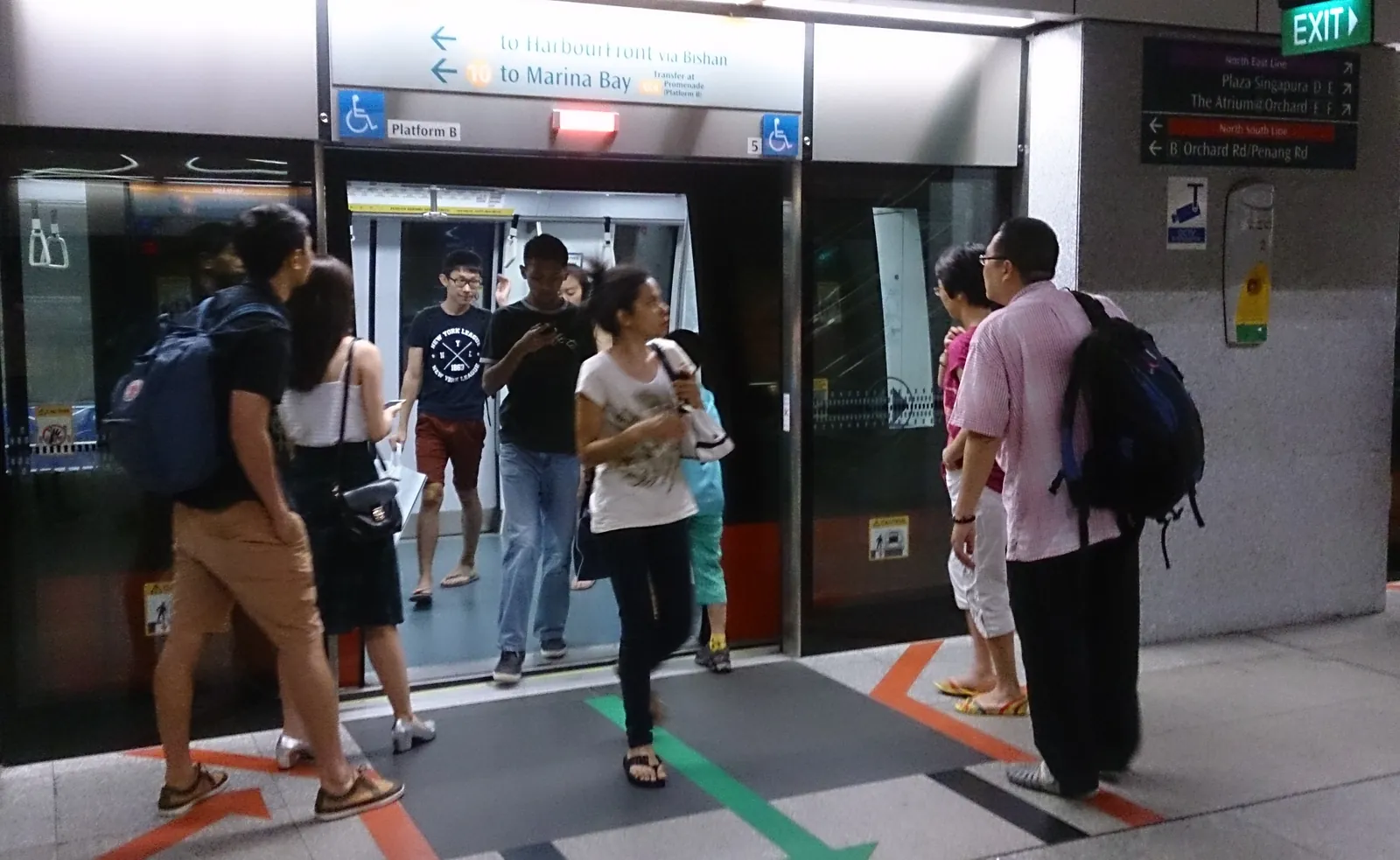
The MRT is six colour-coded lines that reach everything in this guide. Fares by distance, S$1.28 to S$2.57 with a card since the December 2025 rise; a cross-town trip is under S$2. Tap a contactless Visa or Mastercard at the gate (foreign cards work, with a S$0.60 admin charge per day) or buy an EZ-Link card at any station; there are no paper single tickets. Roughly 5:30am to midnight.
Buses use the same card and fares, tap in and out, and reach what the MRT doesn't: East Coast Park, MacRitchie, Changi Village.
Grab is the ride app; a ten-minute ride is S$10–15, with surge at midnight and in rain. Taxis are metered and honest. Walking: within one district, yes; Chinatown to Marina Bay along the river is a pleasant forty minutes. District to district, take the train, because you'll arrive soaked through and whoever you're meeting will notice. Shared bikes (Anywheel, HelloRide) are about a dollar for half an hour.
Skip the hire car, the Singapore Tourist Pass (it rarely pays off at these fares), and the cable car as transport; it's a S$35 attraction.
Things to do alone in Singapore
In the order the heat allows, each with the hour it works at.
1. Maxwell and Chinatown Complex, at lunch
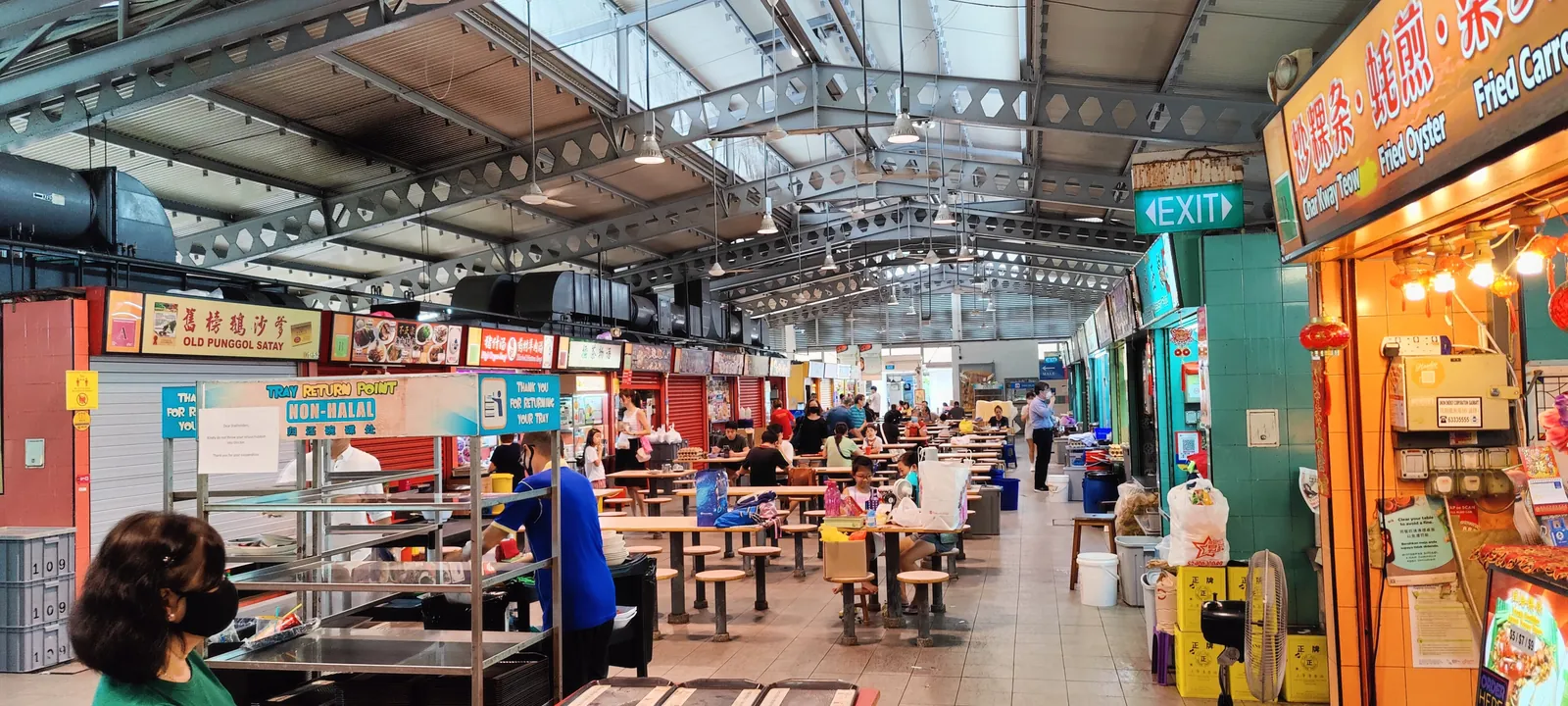
Chinatown Complex is the biggest hawker centre in the country, around 260 food stalls above a wet market; Maxwell, five minutes away, is the famous one with the chicken rice queues. Chicken rice is S$5–6, laksa or char kway teow S$5–7, a kopi S$1.50–2. Go at 11:30 to beat the office rush. Chinatown MRT, Exit A. Do the tissue thing.
2. Gardens by the Bay: free at night, paid when it rains
The Supertree Grove is free and open until 2am, and the Garden Rhapsody light show runs nightly at 7:45 and 8:45pm — lie on the grass for the second one. The two conservatories, Cloud Forest and Flower Dome, cost S$46 together for non-residents (S$34 for residents), open 9am–9pm, and are the coolest room in Singapore in both senses; save them for the wet afternoon. Bayfront MRT.
3. The Marina Bay loop after dark
The 3.5 km walk around the bay — Merlion, Esplanade, Helix Bridge, past Marina Bay Sands and back — takes an hour and costs nothing. Time it for Spectra, the water-and-laser show in front of the Shoppes, at 8 and 9pm, with a 10pm show on Fridays and Saturdays. The SkyPark Observation Deck is around S$30; the rooftop bars in the same tower give you a drink for roughly the same money.
4. MacRitchie and the TreeTop Walk
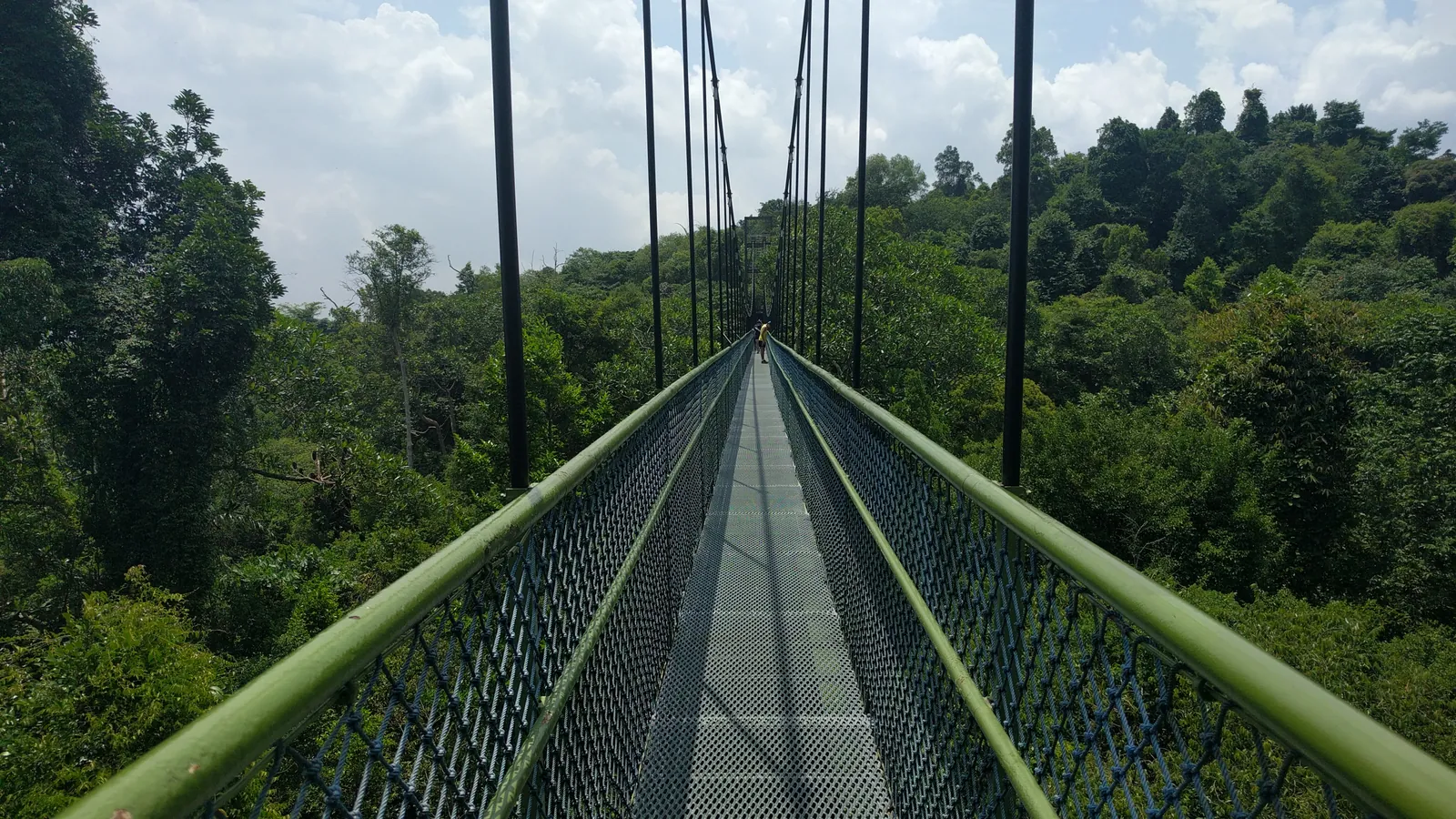
The best morning in Singapore: a free loop of roughly 10 km around the reservoir through real secondary rainforest, with macaques, monitor lizards, and a 250-metre suspension bridge in the middle. The TreeTop Walk is 9am–5pm Tuesday to Friday, from 8:30am at weekends and public holidays, last entry 4:45pm, closed Mondays. Start at seven from the Lornie Road side and you reach the bridge as it opens. Caldecott MRT and a fifteen-minute walk, or bus 130.
5. National Gallery for the 2pm heat
The old Supreme Court and City Hall under one roof, with the largest collection of Southeast Asian modern art anywhere. S$20, open 10am–7pm, City Hall MRT. Two hours inside on a hot afternoon, then the rooftop for a free look across the Padang to the bay. If you want something smaller, the Peranakan Museum on Armenian Street is the one I'd choose.
6. Tiong Bahru before nine
Tiong Bahru Market's second floor is the breakfast hawker centre: chwee kueh (steamed rice cakes with preserved radish, about S$2 for five), lor mee, kopi. Then the estate — curved white Art Deco flats from the 1930s, the bookshop, the bakery queue that's worth it once — and the cafés as they open. Tiong Bahru MRT. By ten it's a different place.
7. Kampong Glam: the mosque, Haji Lane, a murtabak
The gold-domed Sultan Mosque is free outside prayer times (cover up; they lend robes). Arab Street is textiles and perfume; Haji Lane, one over, is bars and murals. Eat a mutton murtabak at one of the old restaurants on North Bridge Road opposite the mosque, around S$8–10 and a full meal for one. Bugis MRT, ten minutes' walk.
8. Little India and Tekka Centre
Tekka is the hawker centre with the wet market underneath and the biryani upstairs (S$6–8 a plate). Sri Veeramakaliamman temple on Serangoon Road is open to visitors and loud in the best way at evening puja; Mustafa Centre is a 24-hour department store at its strangest at 3am. Little India MRT. Sunday evening, when the migrant workers who built the city have their day off, is crowded and worth seeing.
9. East Coast Park on a bicycle
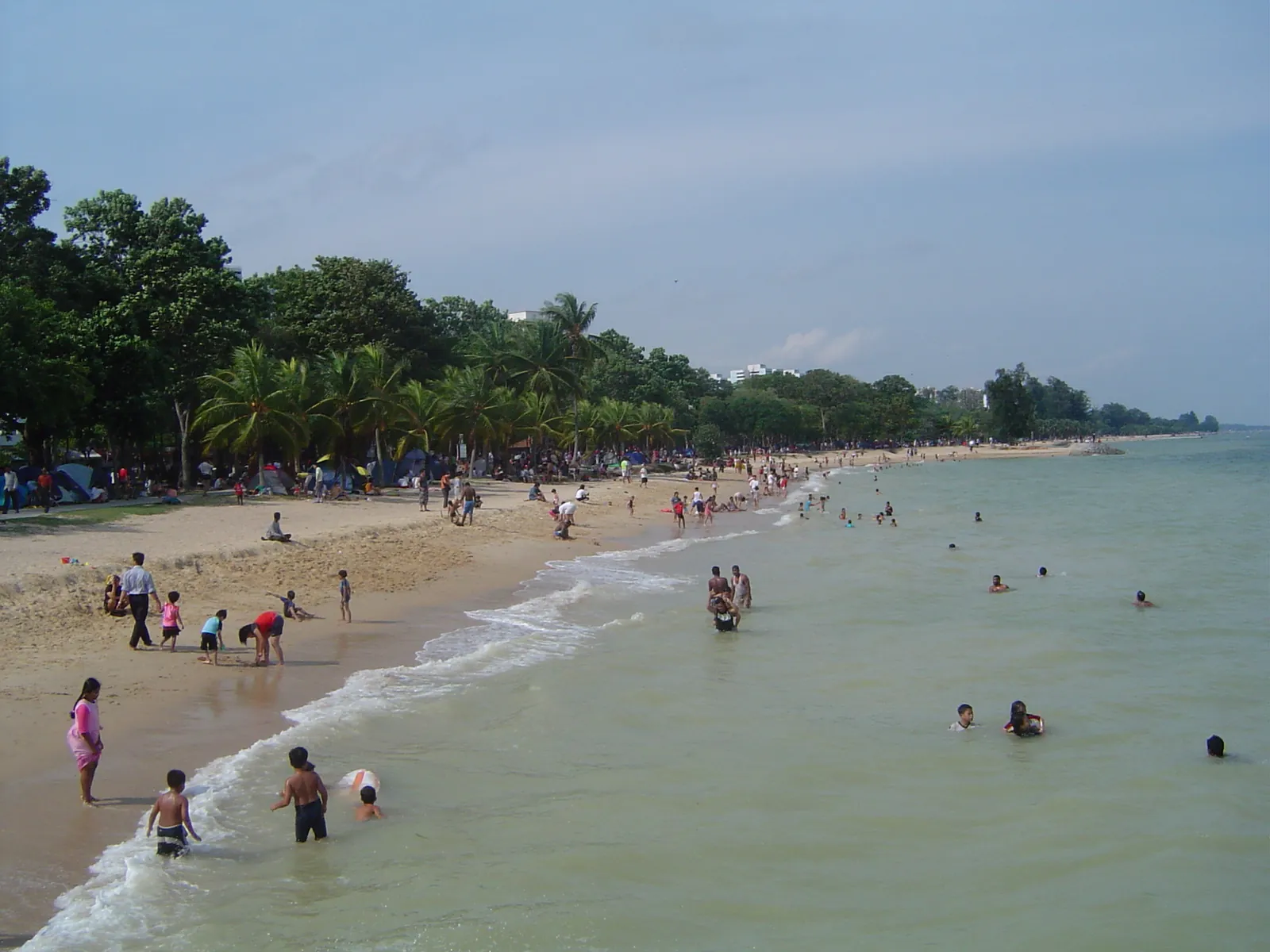
Fifteen kilometres of seafront with a cycle path the whole way, bike hire for around S$8–12 an hour, and the whole city out on it on Sunday morning. Ride east to the Lagoon Food Village for satay or barbecued stingray at a table on the sand. No MRT: bus 401 from Bedok at weekends, or a Grab from Joo Chiat. Go early; by nine the path is a crowd.
10. The Southern Ridges at dusk
A 10 km chain of hilltop parks joined by walkways, from Mount Faber over Henderson Waves — the wooden bridge on every postcard — to Kent Ridge. Free, open all night, best started around 5:30pm so you're on Henderson Waves at sunset. HarbourFront MRT, then the path up Mount Faber, or the cable car (around S$35 return) if you'd rather not sweat.
11. Pulau Ubin
The island that time forgot: kampong houses, dirt roads, wild boar, and the Chek Jawa boardwalk over the mangroves. Bumboats leave Changi Point ferry terminal when twelve people have turned up (S$4 each way, cash) and take ten minutes. Hire a bike on the jetty for anything from about S$8 to S$25 for the day, depending on how many gears you want. Tanah Merah MRT then bus 2 to Changi Village. A full day; go on a weekday.
12. A cooking class or a hawker tour: the only thing here that guarantees a group
Put it on the first day, not the last. A three-hour Peranakan or Singaporean cooking class in Chinatown or Kampong Glam is S$100–150; you pound rempah beside five or six strangers, eat what you made, and there is usually a bar afterwards that somebody knows. Evening hawker tours (S$90–140) do the same job with more food and less washing up. Neither is cheap by Singapore standards, and the food isn't what the money is for: it buys a name in your phone by day two, which nothing else on this list guarantees.
Eating alone in Singapore
Singapore is the easiest city in Asia to eat alone in, full stop. The hawker centre was designed around one person and a tray: queue, pay S$4–8, carry it to any seat at any table, eat, return the tray (mandatory now, and the aunties will tell you). Half the table is alone. Learn the kopi words in the queue: kopi is coffee with condensed milk, kopi-C with evaporated milk, kopi-O black, kosong no sugar, peng iced. S$1.50–2 a cup.
Breakfast is kaya toast, soft-boiled eggs and kopi, S$4–6 at any kopitiam. Lunch is a hawker plate; dinner can be another one. Café and restaurant meals are S$15–30 plus 10% service and 9% GST — the "++" on the menu is real money.
Then there's the other half of the menu. Chilli crab is S$80–120 per kilo, one crab feeds three, and the point is the bread mopping the sauce while four people argue over the last claw. Zi char — the wok dishes at neighbourhood coffee shops, cereal prawns, sambal kangkong, a whole fish — is priced and portioned by the table, and a table of one gets a puzzled look and a fried rice. Satay arrives in tens and twenties; steamboat is a group by definition. Bak kut teh, mercifully, is a bowl for one.
So the tray is sorted, and the crab is not. Where the other three chairs come from is what the rest of this guide is about.
How to meet people in Singapore
Singapore has a reputation as a hard city to make friends in, and the reputation is half right: nobody here is short of company, they're short of hours. Locals work late, expats have a standing Friday, and the traveller in the next bunk flies out on Thursday. So the trick isn't finding people — every hawker table is full of them — it's fitting yourself into a timetable that was written before you arrived.
Sleep in a hostel in Chinatown or Lavender. The ones around Temple Street and Tyrwhitt Road have the common rooms, the rooftop, the whiteboard with tonight's plan. If dorms are behind you, the same hostels rent private rooms for roughly what a budget hotel charges, and the difference is the rooftop at nine. Most people passing through are on a stopover between two other countries: three days, no plans, and a flight on Thursday, which makes them quicker to say yes than travellers anywhere else I've been.
Understand the hours, and that everyone is busy. Singaporeans work late and socialise around food. Weeknight plans start at seven or half past and end by ten; weekend plans start at seven in the morning, because by ten it's too hot for anything but air-conditioning. Run clubs meet at Marina Bay and along East Coast Park on weekday evenings and Saturday dawns — free, drop-in, full of people who moved here within the year. The Botanic Gardens (free, gates open from five in the morning) is the other dawn place, and the one I'd pick if you'd rather walk than run. Most of these groups organise on Telegram and Meetup, which is where Singapore's social life actually lives; search "run club Singapore" the night before and you'll have Saturday's meeting point. Hiking groups do MacRitchie or Bukit Timah on Sunday mornings, and the bouldering gyms (S$30–40 a drop-in) are the most sociable indoor rooms in the city.
Use the transient population. Roughly a third of the people living here weren't born here and the expat crowd turns over constantly, so "I got here Tuesday" is a normal thing to say. Holland Village and Robertson Quay are the old expat bar zones; Tanjong Pagar on a Friday after six is where the finance people go, and the shophouse bar tables are close enough that you'll be talking to the next one by nine.
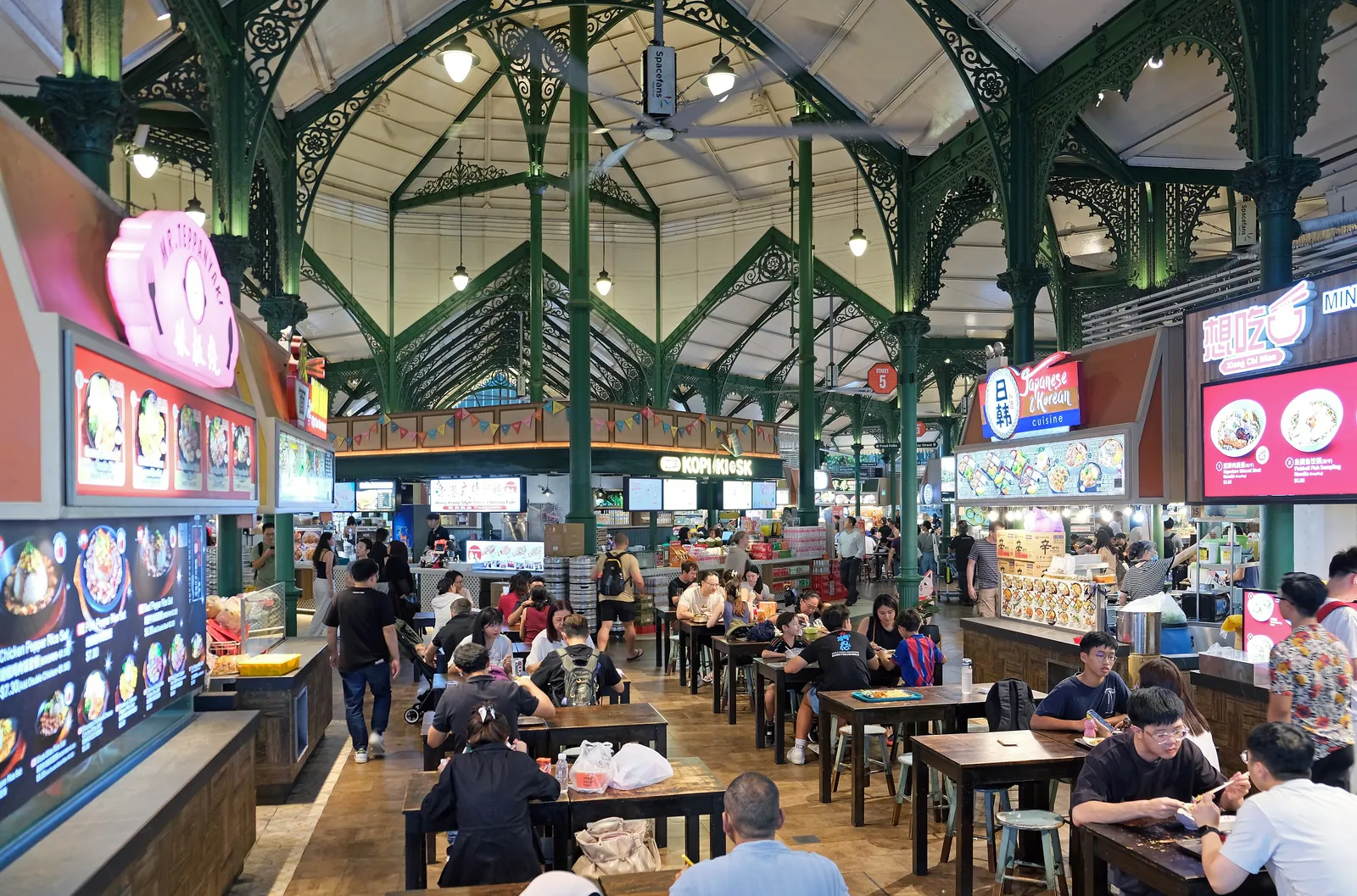
Go where the tables are already shared. The hawker centre is the obvious one, and the way in is food: "what did you get?" works at Maxwell and at Tekka. Lau Pa Sat's satay street is better still: from about seven in the evening Boon Tat Street closes to traffic (earlier at weekends), the tables go out on the road, satay is sold in tens (around a dollar a stick), and the waiters push people together on the long tables. Tiong Bahru's cafés on a weekday morning are full of people on laptops who'll happily tell you about the neighbourhood if you ask.
The class is the shortcut. A hawker table gives you eleven minutes with people who are leaving; a cooking class gives you three hours with people who aren't. By the time the laksa is plated someone has started a group chat and you're in it. Learn enough Singlish to follow the table while you're at it — "can" is yes, "makan" is to eat and also the plan, "paiseh" is embarrassed.
Treat every invitation as the only one. Singaporeans invite once, politely, and don't chase; the hostel crowd is gone in two days. So when someone says "satay street at eight", the Gardens can wait, and when a colleague of a colleague says "we should get a drink sometime", answer with a day. In a city where every diary is full, the person who names a time gets the table. The long version is how to meet people in a new city when you know nobody; the short Singapore one is how to meet people in Singapore on your own.
And when nobody names one, it falls to you. A blank hostel whiteboard in Singapore doesn't mean nobody wants to go out; it means the locals are at work, the expats have their own group chat and the other travellers are as polite as you are. "MacRitchie loop, 7am Saturday, Lornie Road car park" is enough, written up or said out loud in the common room at nine. Two people will come, and two is a group.
And the app we built for exactly this. MeetMap is a map of small plans happening soon near you: a coffee at eight, a run at Marina Bay, a table at the satay street with three seats left. Each pin shows the time, the place and how many seats remain; you take a seat and you're in the group chat. It's free to look and it isn't a dating app. Singapore's plans write themselves once you know the hours — "East Coast bikes, Sunday 7:30", "Tekka biryani, 12:30, two seats" — and the tables are already shared; what's missing is the person who says what time. If the map is quiet in Singapore when you open it, put the first pin down yourself and see who takes a seat.
What Singapore costs per day
Per person, per day, in Singapore dollars, rounded. The shape is unusual: the bed eats the budget and the food barely touches it.
| Budget | Mid-range | Comfortable | |
|---|---|---|---|
| Bed | 45 (dorm) | 180 (hotel) | 400+ |
| Food | 20 (hawker, three meals and kopi) | 55 (hawker plus one restaurant) | 120+ |
| Transport | 6 (MRT) | 20 (MRT and a Grab) | 40 (Grab) |
| One activity | 0–10 (the free ones, or a museum) | 46 (the conservatories) | 100 (class or tour) |
| Day | ~75–85 | ~300 | 660+ |
Cash matters less than anywhere else in the region, but hawker stalls mostly take PayNow or a local QR code, which you won't have, and many don't take foreign cards; carry S$50–100. Tourists can claim back the 9% GST on purchases over S$100 at Changi.
A three-day Singapore plan for one
Day 1 — Chinatown and the bay. Kaya toast and kopi near the hostel. Buddha Tooth Relic Temple (free, from about 7am) and the shophouses before it's hot. Maxwell at 11:30. National Gallery through the afternoon heat. Walk the river to Marina Bay from five, Spectra at eight, then the Supertree Grove for the 8:45 Garden Rhapsody — or the cooking class, if you booked one.
Day 2 — Reservoir and the old quarters. MacRitchie from seven, TreeTop Walk at nine, back by eleven. Shower. Tekka Centre for biryani at one, the temple, then Kampong Glam: the mosque, Haji Lane, an iced tea under a fan. Lau Pa Sat's satay street at half past seven, with whoever you've met or whoever's on the map.
Day 3 — East coast. East Coast Park by 7:30, cycle east for two hours, breakfast in Joo Chiat afterwards (laksa, or Peranakan kueh). Nap, or the conservatories if the afternoon rains. Southern Ridges from HarbourFront at 5:30, Henderson Waves at sunset. Last dinner: zi char at a neighbourhood coffee shop, with a table.
With a fourth day: Pulau Ubin on a weekday; the Night Safari (S$58 for non-residents, tram included, gates from 6pm and trams from 7pm, S$2.50 shuttle from Khatib MRT; the Zoo next door is a little under S$50); or Sentosa (walk in free over the Boardwalk; Universal Studios is around S$85 and genuinely good).
FAQ
Is Singapore safe for solo female travellers?
Yes — probably the safest large city in Asia to travel alone in as a woman. Walking home after midnight and the MRT at night are routine. Keep your drink in sight at Clarke Quay and know that Geylang is the red-light district; beyond that, the usual care, and the lightning.
Is Singapore expensive for solo travellers?
The bed is expensive and everything else isn't. A dorm is S$30–55 and a hotel S$200 and up, but three excellent meals cost S$20 and crossing the city S$2. A realistic solo day is S$75–90 in a hostel, around S$300 in a mid-range hotel.
How many days do you need in Singapore alone?
Three full days for the city, four with Pulau Ubin or the Night Safari. Beyond five, go to Malaysia and come back.
Is it easy to make friends in Singapore?
Easier than its busy reputation suggests, if you use the hours: run clubs and hikes at dawn, the satay street and Tanjong Pagar after seven. The hostel and the cooking class do the introductions; the shared tables and the constant churn of new arrivals mean nobody thinks it odd when a stranger asks what they ordered.
Do I need cash in Singapore?
A little. Contactless card works on the MRT, in taxis, in every mall and restaurant. Hawker stalls and bumboats often want cash or a local QR code, so carry S$50–100.
What can I get fined for in Singapore?
Vaping (device seized, S$700 on the spot, up to S$10,000 in court), eating or drinking on the MRT (up to S$500), drinking in public between 10:30pm and 7am (up to S$1,000), littering, jaywalking, smoking outside marked areas, chewing gum. Drugs are a different category entirely.
Last thing
Singapore did the hard part of eating with strangers decades ago; every hawker table is the proof. What it never got round to is the sentence after you sit down, and that one is yours. Learn the hours and put the tissue packet down. Then, at half past seven on Boon Tat Street, when the waiter asks how many, give him a number bigger than one.
